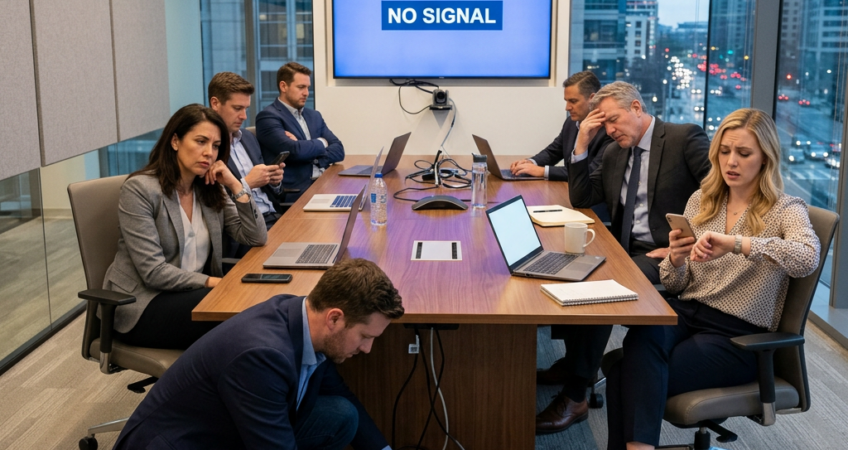
When the meetings start late because your conference room technology isn’t working, productivity is lost.
Your meeting is scheduled for 9:00 a.m. You have five people in the conference room and ten joining remotely. The client presentation is about to begin. But your conference room technology isn’t cooperating.
It’s 8:55 a.m. and the display won’t connect.
Someone crawls under the conference table looking for the HDMI cable. Someone else is asking, “Which remote do we use?”
The next ten minutes turn into troubleshooting before someone finally calls in IT.
The True Cost of Failed Conference Room Technology
Frustration mounts, focus wanes, and productivity is lost. What starts as a minor delay quickly shifts the tone of the entire meeting. Instead of beginning with a clear agenda, the room fills with distractions, side conversations, checking email, everyone’s attention has drifted before the discussion even begins.
From an operations standpoint, that’s a real and measurable cost. A single leadership meeting can easily represent hundreds of dollars in payroll, but the impact goes beyond the hourly rate. Decisions are delayed, conversations are rushed to make up for lost time, and valuable input is often missed. What seems like ten minutes of troubleshooting can quietly erode the effectiveness of the entire meeting. Multiply that across multiple meetings each week, and it adds up quickly over a quarter or a year.
And then there’s the impression it leaves. When a client is sitting in the room or waiting remotely, those first few minutes set the tone. Technical issues don’t just interrupt the meeting; they undermine confidence. Instead of focusing on your message, your team is focused on solving a problem they never considered and shouldn’t have needed to. In a competitive environment, that loss of credibility can carry far beyond a single meeting.
The Real Issue of Conference Room Technology
Most conference room technology problems aren’t caused by a single failing device. They’re the result of rooms built from a fragmented, piecemealed collection of systems modified and added to over time. A display from one vendor, a conferencing platform the IT provider brought in, audio equipment layered in later, and control systems that don’t fully communicate with each other. Each component may work on its own, but together they create friction, multiple steps to start a meeting, confusion around inputs and controls, and increased points of failure.
The Solution
In a truly integrated environment, the technology becomes almost invisible to the user. There’s no guessing which input to select, no switching between remotes, and no dependency on IT to get a meeting started. A single touch interface brings everything together, allowing users to walk in, start their meeting, and focus on the conversation at hand. By eliminating the friction between devices, integrated systems reduce delays, improve user confidence, and create a consistent experience across every room. That consistency is what transforms meeting spaces from a source of frustration into a reliable business tool.
We design and implement integrated conferencing systems built on proven platforms such as Q-SYS. This brings conferencing, cameras, audio, and room controls into a single coordinated system.
Ready to optimize your meeting productivity? Contact us today and let’s build a system together.